
Inlays in Darien
A conservative middle ground between a filling and a crown: a lab-made restoration bonded into the tooth that keeps more of your own structure.
Some cavities are too big for a filling to hold reliably but nowhere near big enough to justify cutting the tooth down for a crown. An inlay is the answer to exactly that situation.
What’s included
- A conservative alternative to a full crown
- Custom made in a dental laboratory, then bonded in
- Keeps more healthy tooth structure than a crown
- Stronger and longer-lasting than a large filling
- Also used to treat tooth decay in some cases
About Dental Inlays
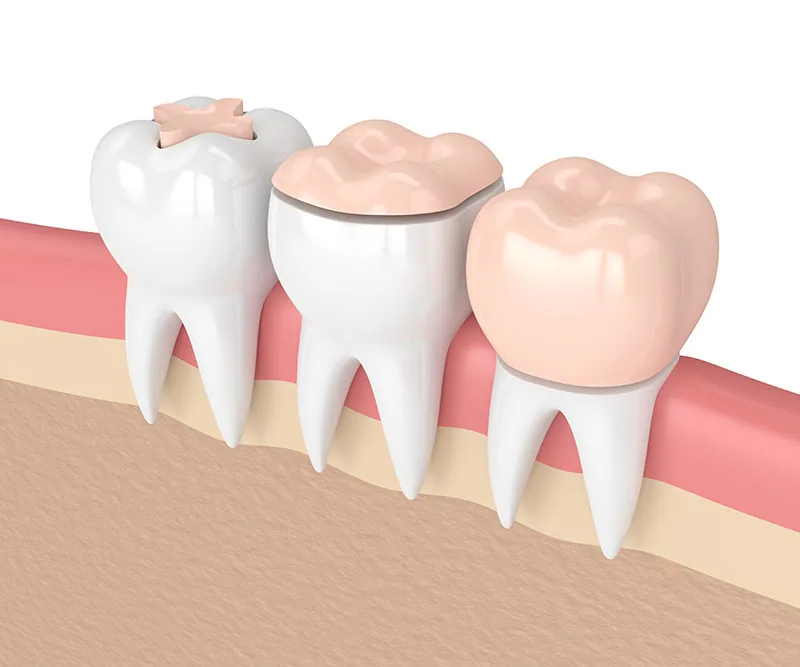
Here at B & R Dentists, we are proud to offer dental inlays for our patients. Dental inlays are considered a conservative method of treating damaged teeth. They are used instead of placing a crown. Some dentists even use inlays to treat tooth decay. Instead of filling in the tooth, your dentist may use dental inlays. Dental inlays are made in a dental lab and then fitted to your tooth. They are then bonded to your tooth. The difference between inlays depends on how much of your tooth it covers. If the material is bonded to the center of the tooth, it is considered an inlay.
When an Inlay Is the Right Choice
A cavity or fracture in the chewing surface of a back tooth that is wider than a filling can reliably support, but where the cusps — the raised points of the tooth — are still sound. An old, large filling that keeps chipping at its edges or that has decay starting underneath it. A tooth where you want to preserve as much natural structure as possible, particularly in a younger patient where a crown now means a bigger restoration later. A situation where strength matters because of grinding or a heavy bite. If the cusps themselves are cracked or undermined, the restoration needs to cover them, and that is an onlay or a crown rather than an inlay. We will tell you which category your tooth falls into.
Benefits of an Inlay
The main benefit is what is not removed. A crown requires reducing the tooth on all sides; an inlay only replaces the damaged portion, so significantly more of your own enamel and dentine stays. Since the amount of remaining tooth structure is the single biggest predictor of how long a tooth survives, that is not a cosmetic distinction. Because an inlay is fabricated outside the mouth on a model, it can be shaped and contoured with more precision than a filling built up in layers against a neighbouring tooth, which means tighter contacts, better bite anatomy and less food packing. Lab-made materials are also more wear-resistant and shrink less than direct composite, so inlays typically outlast large fillings by years.
What to Expect
The tooth is numbed and the decay or old filling removed, and the cavity is shaped to a form the inlay can seat into. We take a digital scan with the iTero, so no putty impression is needed, and a temporary restoration protects the tooth while the laboratory makes the inlay, usually about two weeks. At the second visit the inlay is tried in, the fit and contacts are checked, and it is bonded into place with adhesive cement, then the bite is adjusted and the margins polished. It requires two visits rather than one, which is the trade-off against a same-day filling. Afterward it is cleaned exactly like a natural tooth, with the usual attention to flossing at the margins.
Common Questions
What is the difference between an inlay and an onlay?
Why not just have a large filling?
Will it be visible?
How long do inlays last?
Is it more expensive than a filling?
Terms You May Hear
- Inlay
- A lab-made restoration bonded into the centre of a tooth, between the cusps.
- Onlay
- The same idea, but extending over one or more cusps: used when the cusps also need protecting.
- Cusp
- One of the raised points on the chewing surface of a back tooth. Their condition decides inlay versus onlay versus crown.
Related Services
Ready to Schedule Your Appointment?
Want to know whether an inlay would work for your tooth? Call (630) 427-1800.