

You had a toothache for a few days. It was bad enough that you thought about calling a dentist. Then one morning it was gone, and it has not come back. Most people treat that as the end of the story.
Sometimes it is. But a toothache that stops by itself is one of the few situations in dentistry where feeling better and getting better are not always the same thing.
When it really was nothing
Plenty of tooth pain is temporary and harmless. A piece of food wedged under the gum, a sinus cold pressing on the upper back teeth, a few days of sensitivity after whitening, or a tooth you bit down on awkwardly can all cause an ache that settles and stays settled.
If the pain was mild, lasted a day or two, and had an obvious cause, there is usually nothing to chase.
When the pain stopped but the problem did not
A deep cavity or a crack lets bacteria reach the nerve inside the tooth. The nerve becomes inflamed, and that is the toothache: throbbing, worse at night, set off by hot or cold.
If nothing is done, the nerve can eventually die. A dead nerve cannot send pain signals, so the tooth goes quiet. The infection that killed it is still there. It carries on at the tip of the root, in the bone, usually without symptoms for a while.
What tends to follow, weeks or months later, is an abscess: swelling, a bad taste, or pain that returns more sharply than before. At that stage the choices are narrower than they were when the tooth first complained.
Signs the tooth should be looked at
These point toward the second kind of toothache, even if you feel fine today:
- The pain was strong enough to wake you or to need painkillers for more than a day or two
- Hot or cold used to set it off and the ache lingered after
- The tooth looks darker or grayer than the ones next to it
- A small pimple-like bump on the gum near the tooth, which may come and go
- A bad taste, or an odor from one area that brushing does not fix
- The tooth feels slightly raised, or tender when you tap or bite on it
- A sharp twinge when you release a bite, which often points to a crack
Swelling in the face or jaw, fever, or trouble swallowing is different. That needs to be seen the same day. Our guide to what counts as a dental emergency covers what to do first.
What we do at the visit
Working out which kind of toothache you had is quick and not uncomfortable:
- A look and a few simple tests. We check how the tooth responds to cold, to tapping, and to biting pressure. A tooth that no longer feels cold at all tells us a lot.
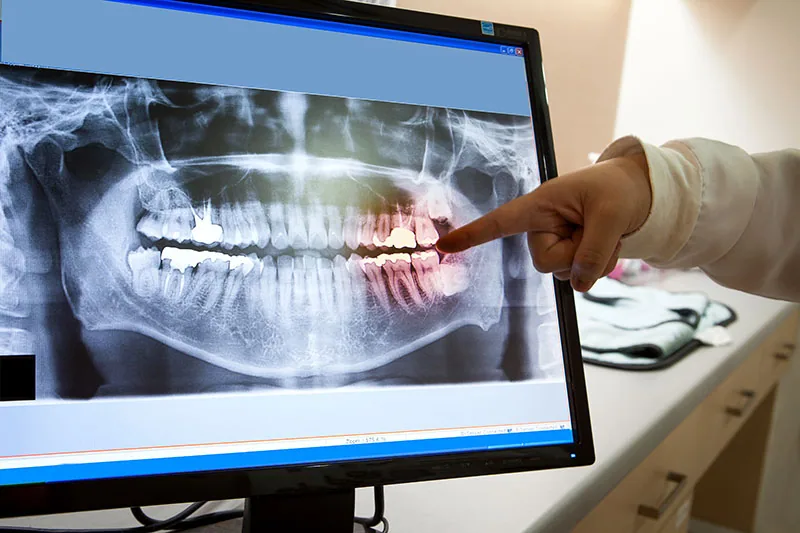
- A digital X-ray. Digital X-rays show decay between teeth, cracks in old fillings, and changes in the bone at the root tip that cannot be seen any other way. The image is on screen right away, and we show you what we are looking at.
- A straight answer. If the tooth is healthy, we tell you so and you can stop wondering.
What treatment looks like, by stage
- Decay that has not reached the nerve: a filling.
- A cracked or heavily filled tooth: a crown to hold it together before the crack travels.
- An infected or dead nerve: a root canal, usually finished with a crown. This removes the infection and keeps the tooth.
- Too little tooth left to save: an extraction, and a conversation about replacing it.
The earlier on that list a tooth is caught, the simpler the appointment. That is the whole reason not to wait for the pain to return and make the decision for you.
A word on root canals, since the name puts people off: the procedure is done with the tooth fully numb. You feel pressure, not pain. The pain people associate with a root canal is the infection they came in with, and the treatment is what ends it.
Common questions
Can a tooth infection go away without treatment?
No. The symptoms can fade, but an infection inside a tooth does not clear up by itself, because the body cannot reach it. Antibiotics can calm a flare-up for a time. They do not remove the source.
My toothache comes and goes. Is that the same thing?
Pain that comes and goes, especially when biting, is often a cracked tooth or a failing filling. Both are much easier to fix before the crack reaches the nerve.
How long is it safe to wait?
There is no set number. If you had real pain and it has stopped, having it checked in the next week or two is a reasonable target. Sooner if anything on the list above applies.
I do not have insurance. What will a check cost?
Uninsured patients can have an exam and X-rays for $99. See our specials page for that offer and for financing through Cherry.
Getting it checked in Darien
If a toothache has gone quiet and you would rather know than guess, call B&R Dentists at (630) 427-1800 or request an appointment. We are at 2861 83rd St. in Darien and see patients from Woodridge, Downers Grove, Westmont and the surrounding area. We are open until 6pm on Tuesday, Thursday and Friday, and on Saturday from 9am to 2pm.