Dental Implants in Darien
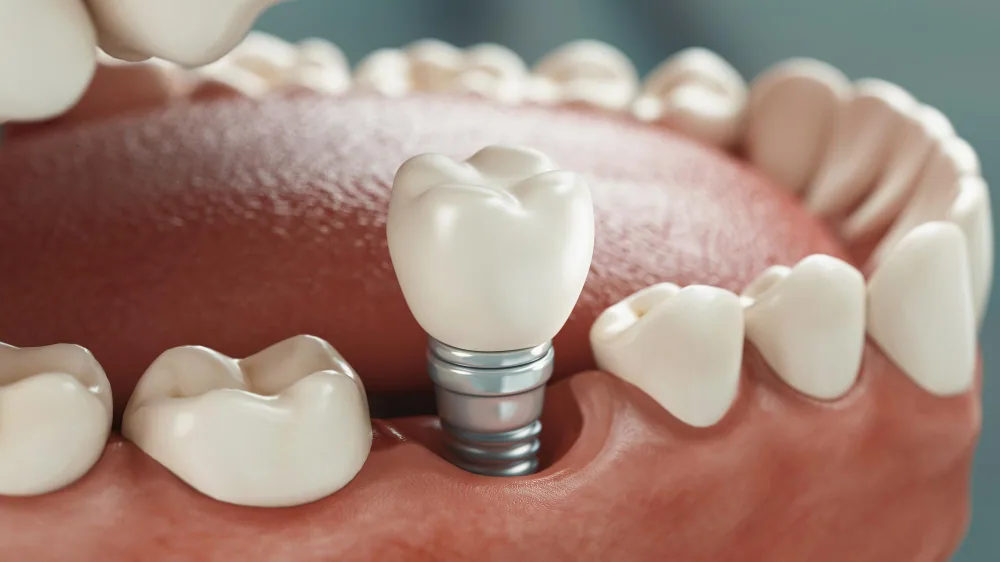
Implants replace the root of a missing tooth, giving a fixed, natural-feeling replacement that does not rely on the teeth beside it.
An implant is the only tooth replacement that also replaces the root. That is what makes it feel like a tooth rather than something sitting on top of the gum.
What’s included
- Replaces the root as well as the visible tooth
- Does not require altering the neighbouring teeth
- Implant-based care within Dr. Ammar's clinical scope
- Can secure a loose lower denture
- Helps preserve the jawbone at the missing tooth site
About Dental Implants
Dental implants are roots placed in your mouth for either permanent teeth to be placed on or ones that you can remove. Dental implants are done to improve a patient's smile and usually their self esteem. Having missing or bad teeth can be quite embarrassing. Dental implants also can be done to improve oral health. Many people find it easier to eat with dental implants. Their speech can also be improved. Dental implants are also more comfortable because they are made to become permanent. Dr. Ammar's clinical scope includes restorative dentistry, endodontic treatment, surgical procedures, orthodontics, and implant-based care, allowing patients to receive a wide range of treatment in one office.
Reasons to Consider an Implant
A single missing tooth where you would rather not crown the healthy teeth on either side to carry a bridge. A tooth that is failing and will need removing, where planning the replacement in advance produces a better result. Several missing teeth in different parts of the mouth. A lower denture that will not stay put. Two implants can turn a denture that moves into one that clips firmly into place, which is often the single biggest quality-of-life change we see. A gap that has been left for a while and where the bone is beginning to shrink. And the reason people give most often when asked directly: wanting to stop thinking about it, and to eat without planning around a gap.
Benefits of Implants
The neighbouring teeth are left alone. With a conventional bridge, two healthy teeth are cut down to carry the replacement; an implant stands on its own, so nothing else is altered. The bone is preserved: a tooth root stimulates the bone around it, and when the root is gone that bone resorbs, which is why long-standing gaps develop a visible dip. An implant restores that stimulation. It is fixed, so nothing moves while you eat and there is nothing to remove at night. Chewing force is close to that of a natural tooth, so hard and chewy foods stay available. And implants cannot decay, though the gum around them still needs the same daily care, because they can be lost to gum infection if that is neglected.
What to Expect
It begins with planning: X-rays and a clinical assessment establish whether there is enough bone and where exactly the implant should sit relative to the nerve and sinus. The implant post is then placed into the jawbone under local anaesthetic. Most people are surprised that this is a less uncomfortable recovery than an extraction. The site is then left to integrate. The bone grows onto the implant surface over roughly three to six months, and this waiting period is the part that cannot be rushed, because it is what makes the implant permanent. Once integrated, a digital impression is taken and a crown is made and fitted onto the implant. If a tooth still needs removing first, or if bone volume is insufficient, extra stages such as grafting may be needed and we will lay that out, including timing and cost, before anything begins.
Common Questions
How long does the whole process take?
Is placing an implant painful?
Am I too old for an implant?
How long do implants last?
Does insurance cover implants?
Terms You May Hear
- Osseointegration
- The process by which jawbone grows directly onto the implant surface, locking it in place. It is why implants need months to heal.
- Abutment
- The connector that joins the implant post in the bone to the crown above the gum.
- Bone graft
- Adding bone material to a site with insufficient volume, so an implant has enough support to be placed.
Related Services
Ready to Schedule Your Appointment?
Want to know whether you are a candidate? Call (630) 427-1800 to arrange a consultation.