
Losing a back tooth rarely feels urgent. Nobody can see the gap, you can still chew, and after a few weeks you stop noticing it. So the decision about replacing it gets put off, often for years.
The gap itself is not the issue. What matters is what the rest of your mouth does in response to it, and most of that happens in the first year.
What changes once a tooth is gone
The bone starts to shrink
Your jawbone keeps its shape because tooth roots put it to work every time you chew. When a root is gone, that area of bone no longer has a job, and the body gradually takes it back. The ridge becomes narrower and lower, and most of that change happens in the first year after the tooth is lost.
You will not feel this. It matters because bone is what a dental implant is anchored in. The more that is lost, the more involved replacing the tooth can become later.
The neighboring teeth drift
Teeth stay upright partly because they lean on each other. Take one away and the teeth on either side start to tip into the space. The tooth above or below, with nothing to bite against, slowly grows out of the gum toward the gap.
This is gradual. Over time it can change how your teeth meet, open up spaces where food packs in, and make the tilted teeth harder to clean, which raises their risk of decay and gum problems.
The other side does more work
Most people start chewing on the opposite side without thinking about it. Those teeth then take more wear, and any large fillings or older crowns on that side are under more load than they were built for.
Does every missing tooth need replacing?
No, and we will tell you if yours does not. Wisdom teeth are not replaced. Some back teeth with nothing opposing them can be left alone. The answer depends on which tooth it is, how your bite fits together, and the condition of the teeth around it. That is what a consultation is for.
Your options
Dental implant
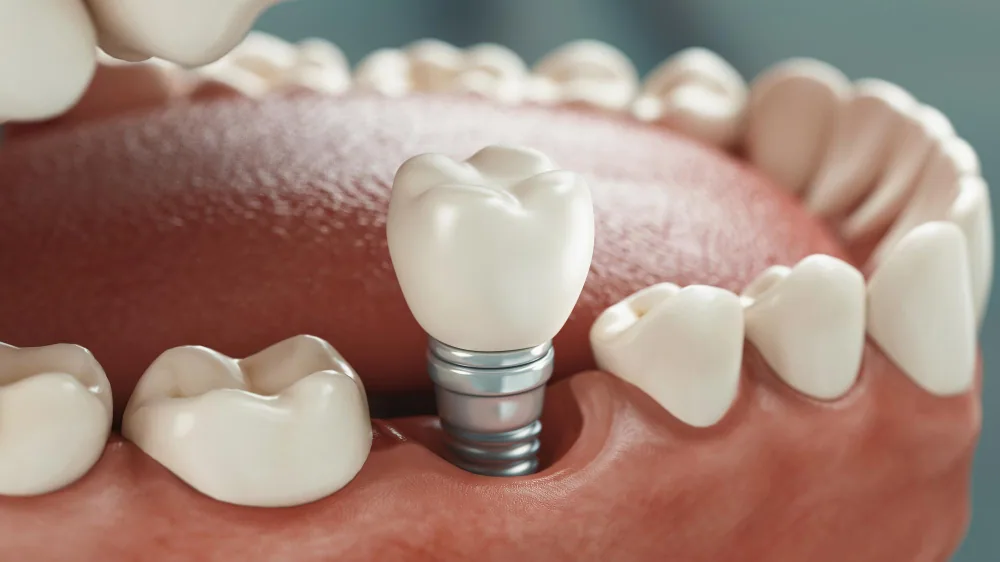
An implant replaces the root as well as the visible tooth. It does not rely on the teeth beside it, so they are left untouched, and it helps preserve the bone at that site. It takes the longest from start to finish, because the implant needs time to heal into the bone before the final tooth goes on. Dr. Ammar provides implant-based care and can tell you whether you are a candidate. More about implants.
Dental bridge
A bridge fills the gap with an artificial tooth anchored to the teeth on either side. It is fixed in place and is usually completed faster than an implant. The trade-off is that the supporting teeth have to be prepared for crowns. More about bridges.
Partial denture
A removable partial replaces one or several teeth and clips onto the teeth you still have. It is the least invasive route and can be a good choice when several teeth are missing. More about dentures.
Why the timing matters
All three options work best, and are simplest to do, when the bone is still there and the neighboring teeth have not yet moved. Waiting does not take options away overnight, but it does slowly make them harder. A space that was a straightforward implant in the first year can need extra steps a few years on.
If your tooth came out a while ago, that is not a reason to assume it is too late. It is a reason to find out where things stand.
No putty impressions
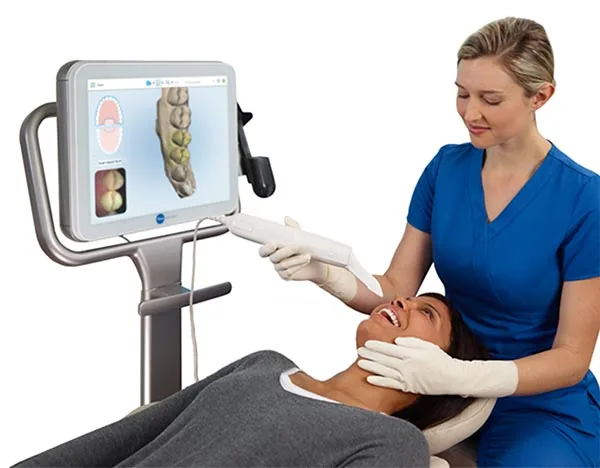
Crowns, bridges and implant restorations all need an exact model of your teeth. We take that with an iTero digital scanner, a small wand that builds a 3D image of your mouth. There are no trays of putty, and you can breathe, swallow and pause normally during the scan.
Common questions
How soon after an extraction should I think about replacing the tooth?
Ideally, have the conversation before the tooth comes out, or soon after. Planning early keeps the most options open.
My tooth has been missing for years. Can it still be replaced?
Often, yes. An exam and X-rays show how much bone remains and whether the nearby teeth have shifted, which tells us what is realistic.
Is an implant always better than a bridge?
Not always. It depends on your bone, the condition of the neighboring teeth, your health, and your budget. We go through the options that fit your situation and you choose.
How do people pay for this?
We check insurance coverage before you arrive. For the rest, we work with Cherry so treatment can be paid over time. Details are on our specials and financing page.
Finding out where you stand
If you have a gap you have been meaning to deal with, a consultation at B&R Dentists will tell you what has changed and what your options are. Call (630) 427-1800 or request an appointment. We are at 2861 83rd St. in Darien, close to Burr Ridge, Willowbrook and Downers Grove.